
Spray painters are excellent to add primer, paint car surfaces mix and match colors and applying coats of finishing. But the possibilities don’t end there. Spray paint guns are used for a lot more than just the one or two tasks I mentioned above. Spray painters can be used to handle a variety of paint, but in order to achieve the best results, you’ll require some tweaks which is what we’ll be looking at in this article.
Spraying a broad range of different types of paint using an air gun, provided that the paint is thin enough to prevent getting stuck in the gun. Latex, water-based paints and primers and vinyl, as well as alkyd, lacquer enamel, high-heat paint and oil-based paints epoxy, rust-preventive spray and plastic paint can all be used using a paint sprayer. However, the results will differ depending on the paint sprayer and turbine you’re using, in conjunction along with the viscosity and viscosity.
The topic of spray paint guns can be complicated because there are a variety of kinds of guns and they’re not equal with all paints and given the wide variety of paints that are available, it can become rather complicated.
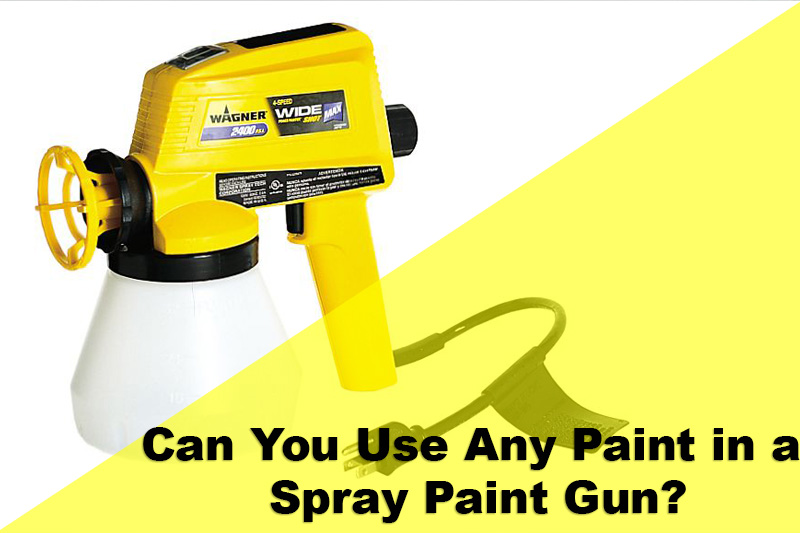
The simple fact the fact that any gun could spray any kind of paint isn’t enough. You need to know how it handles the paint to achieve the most efficient outcomes.
Also Read: Is Spray Painting Indoors Safe?
What kind of paint can you put into the Spray Gun? Spray Gun?
Understanding how spray paint guns operate and the purpose for which they’re designed will help you build your knowledge. Before we get into painting, I’ll give you a few tips that can help as we get into the discussion about the paints.
The two most popular paint sprayers frequently used to paint at home are the HVLP and LVLP paint sprayers. They’re also known as low-volume high-volume, and low volume low-pressure painters. Other alternatives that are well-known include the airbrush, airless sprayers or compressors for air.
- HVLP Low volume, high tension. This paint spray gun is able to atomize paint at a quicker pace than LVLP. The pressure that draws paint to the nozzle before releasing it onto the surrounding surface is 10 PSI or greater and is greater than the counterpart with the lower volume. This sprayer is ideal for spraying thin materials, but might have issues spraying heavier paints, including primers and oils, with 10 PSI. For heavier paints, the HVLP could require a strong compressor to achieve the most effective outcomes.
- LVLP Low volume, Low pressure. Low-volume guns are often employed to create more precise and detailed details in direct consequence of lowering pressure which limits the spread. Additionally, this allows the LVLP an excellent choice for paints with low viscosity. Although the LVLP can be used to make lacquers, primers, latex water-based paints and auto paints, they’re necessarily the best choice, but it is the last option.
- Turbine Powering The Machine These machines require power to create enough force to spray paint. Different paints require different amounts of power to spray smoothly. The machines draw power from an outside unit, an engine. The more power a project needs, the more powerful (and oft times, more costly) the turbine needs to be. The power generated and needed is categorized into “stages” which are 2 as the lowest , and 5 the most powerful. Compensors can be then added to boost power even more.
These guns are employed for a variety of paints and projects, selecting the wrong gun will yield sub-par results in comparison to what you can achieve using the correct paint that is in the correct gun. No matter which paint you choose it’s essential to thin the paint using water or some other thinner, like mineral spirits and acetone prior to spraying the paint using your sprayer.
Let’s look at each of the paints, in particular.
Can you use water-based paint in a Sprayer? Sprayer?
There are many environmentally-friendly paints available on the market today, including water-based paints. Water-based paints are made up of a binder and pigment, with water acting to transport the paint. They are the most popular choice for painting interiors and are used on ceilings, walls as well as exterior and interior metal and wood and more.
Both are used by professional and hobbyist painters regardless of of expertise. Most often, they are applied with brushes or rollers that is longer-lasting than using the spray painter. Water-based paints may certainly be used with a spray painter and yield great results if used correctly.
To apply water-based sprays (acrylic or latex) you’ll need the minimum of four stages of turbines, but 5 is recommended and paint thinning is necessary in many instances. Utilizing smaller turbines will make you to thin the paint to the point that it’s no more usable.
A wall painted with the use of a roller or brush takes a lot longer than with the spray gun. For those who aren’t at ease with spray painters due to fears of being a mess. There’s no need to worry as there are plenty of videos on Youtube that can show you how to use it.
There is some misconceptions about water-based paints and their durability levels. It’s possible that people think that it’s not as durable than solvent-based counterparts, but this is not the case. It’s possible to expect the same durability and performance when you use water-based paint.
Can you use Acrylic Paint with the spray paint gun?
Acrylic paint is among the many water-based paints we employ on a regular basis for household projects. Because it’s water-based you’ll be able to employed in a spray gun to get faster and more effective outcomes, just like we discussed above.
Also, an advanced stage four or five turbine is necessary and a small amount of thinned paint is likely to be required when spray painting acrylic paint. You might be tempted to choose a less-staged spray painter for an affordable price, but the result won’t be a hit with anyone, therefore it’s better to invest a bit more to get good results from the beginning.
Can you use latex in the Paint Sprayer?
Yes you can spray latex paint. The most efficient way to do this is using an airless sprayer. you could hire at your local paint shop at a cost of no more than $100 If you reside somewhere in the US.
Other sprayers are also able to handle latex but will need you to reduce the thickness of your paint until a suitable consistency to prevent it from clogging the sprayer. Since it’s a water-based painting, it’s extremely dense and needs to be thinned to allow the sprayer capable of spreading it evenly.
Latex must be thinned by using water since it is the primary carrier for the latex paint’s solids. It is possible to use a high-volume paint gun to spray latex, but it requires a lot of power, and the paint should be thin enough, that’s why I suggest using an airless sprayer for any projects which require latex paint.
Do You Need to Use Primer in the Paint Sprayer?
Primer paints can be applied with brushes, rollers or spray painter. they’re all able. Spray painting is beneficial as it is less time-consuming and can provide the perfect base for applying your most dazzling coats. The ability to make even coats in the manner that the spray painter creates is difficult with a brush or roller unless you’re proficient.
Certain primers might be too thick for the spray painter and will require to be thinned before spraying them with the sprayer to avoid getting blocked. Certain primers are, however, designed for use by spray painters, and will be at the right level right from the bottle. Some primers are removed from use when thinned, so be sure to research the primer prior to spraying.
Try to avoid thinning the primer whenever you can. It’s best to buy a primer already ready to spray immediately from the beginning.
Can you use Gloss Paint with a Paint Sprayer?
It is not recommended to spray gloss. It is for a number of reasons, firstly, it contains cyanide and can cause harm in your overall health. To combat the toxins present in the air, you’ll need a healthy air supply and an air purifier that has an HEPA-filter. It should run for a few days prior to you think about spending time at the site without proper safety equipment.
Application of gloss paint using the sprayer needs precision to ensure that it doesn’t get clogged. However, you could damage the quality in the paint through thinning it, and thereby reducing its quality.
Thin gloss paint must be applied outdoors to prevent the build-up of fumes. The majority of the paint spray will air-borne and leave you with extremely sticky air filled with contaminants that are lingering around the room.
It is possible to spray gloss, but it requires the right preparations and could be costly when you think about all the equipment you need to be aware of to protect yourself. Employing a professional or applying it using an air-tight roller is likely to be the most effective option in this instance however it might be more costly or laborious as compared to spray painting.
Is it possible to use lacquer in the Paint Sprayer?
It is possible to spray lacquer utilized in a paint sprayer, but it is best to use an extremely fine tip because it helps make the paint atomize and is more crucial when spraying lacquer rather than in spraying latex.
Applying lacquer using the correct tools will provide the smooth, perfect appearance that any project should receive. I’ve been using Magnum Graco to apply lacquer for quite a while and it’s made a significant difference that it’s much easier to justify buying it even though it’s an economical option within its price range.
As a final point, it’s essential to clean your tools well to avoid lacquer from mixing into other paint. It’s likely that there will be particles in your pump after you’ve finished spraying. It’s possible to have small globs or specks of paint if it’s applied to a sprayer that’s had leftover paint particles within it.
The best solution would be to change between 2 pumps and also to have dedicated equipment that is solely for the purpose of spraying lacquer. But since this isn’t a choice for all Cleaning the sprayer correctly is the second best solution.
Can you use Enamel within a Paint Sprayer?
It is possible to spray paint using a spray gun for paint but you’ll need blend it into a thinner. In case you thin out too significantly, it won’t completely cover the surface, therefore, look for the correct proportion of the product’s label be sure that you are doing it correctly.
I’m not going to give general ratios since there are too many products on the market and I’m not capable of ensuring that you will succeed. The label must however provide you with all the information necessary to know the amount of thinner’s agent your product will absorb.